Are you about to equip your hospitality business with new equipment? Then you’ve probably already discovered that professional catering equipment costs quite a bit more than that fancy consumer version you saw at the electrical store. And then you wonder: is that difference really that big? Spoiler alert: yes, absolutely. But not for the reasons you think.
The hospitality world runs on different rules than your home kitchen. Where you might cook twice a day at home, a professional kitchen must produce hundreds of dishes a day. You can see that difference in every aspect of the equipment. From the motors to the materials, from the certifications to the service capabilities. In this article, we dive into what really makes hospitality equipment different, what trends we see in 2025 and why that higher investment may ultimately be the best decision.
The fundamental difference: intensity and volume
The biggest difference between hospitality and consumer appliances? The intensity with which appliances are used. A household refrigerator cools one family’s groceries. A hospitality refrigerator must constantly fight temperature fluctuations as employees open it dozens of times a day during busy shifts.
Take a deep fryer, for example. At home, you deep fry maybe once a week. In a busy snack bar, that same fryer produces fries non-stop for hours.
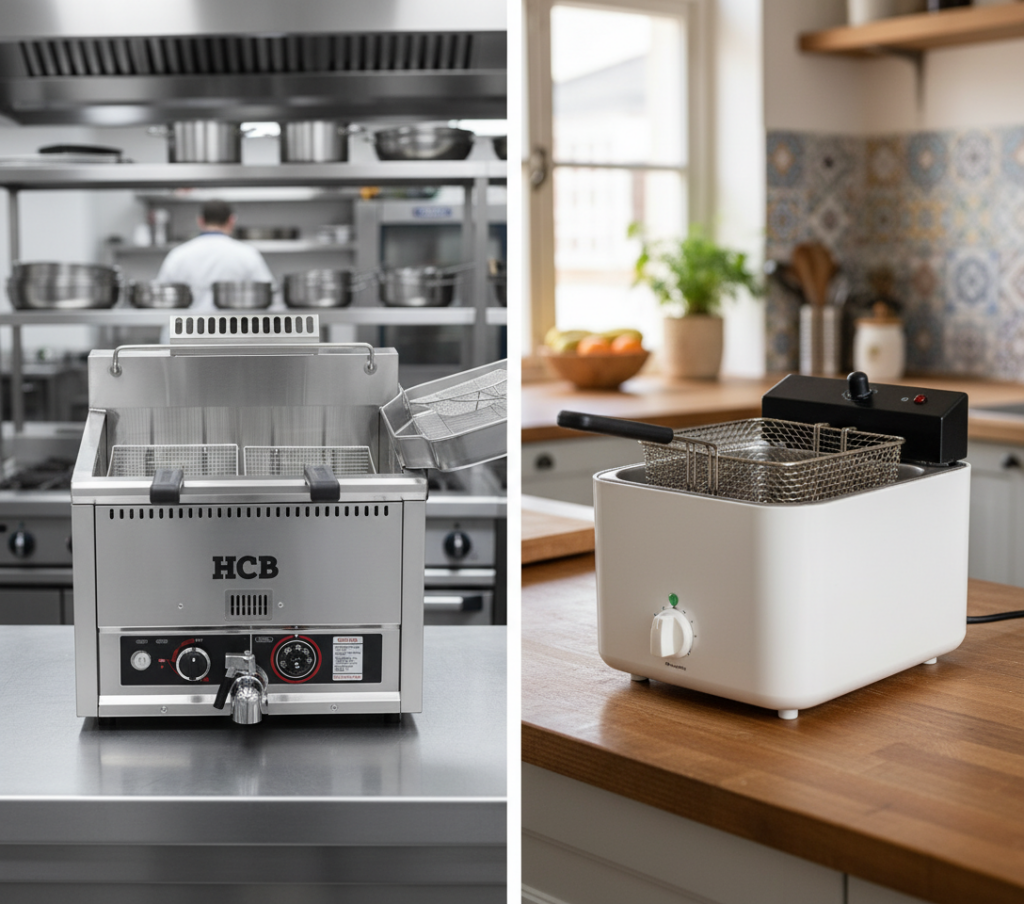
This calls for:
- Powerful heating elements that restore temperature quickly
- Better insulation to avoid energy waste
- Robust construction that can handle constant use
- Easier cleaning options for daily maintenance
A consumer model would fail within weeks under these conditions. Professional fryers are designed to last for years, even with heavy use. This applies to all the appliances in your kitchen, from your ovens to your dishwashers.
Built for the battle: durability and construction quality
When you pull open a professional appliance, you immediately see the difference. Where consumer equipment often has plastic components, in hospitality equipment you find mostly stainless steel and other durable materials. Not for show, but because it simply has to be.
Moreover, professional devices are modular. Broken parts can be replaced without throwing away the whole device. With consumer equipment, repair is often more expensive than replacement. With hospitality equipment, you invest in repair options. A broken compressor in your refrigerated workbench? You replace it, and your workbench will last for years again.
The difference is also in the details. Thicker metal plates, heavier hinges, reinforced door openings. Everything is designed to take a beating in a busy kitchen environment where efficiency is paramount and there is no time to be careful with equipment
Capacity that really makes a difference
Imagine: Saturday night, full case, thirty orders at once. Your domestic oven would collapse under the pressure. A professional hot-air oven, meanwhile, quietly bakes five levels at once, with perfect temperature distribution.
You see this capacity difference everywhere. A household dishwasher might do ten plates per cycle. A professional hospitality dishwasher? That rinses eighty plates per hour, with a cycle of only two minutes. That’s not only faster, it’s more efficient in terms of water and energy consumption per plate.
In refrigeration, the difference is even more striking. Professional refrigerators have powerful compressors and better air circulation. Why? Because they need to be able to cool from 20 to 4 degrees within minutes when storing freshly brought in produce. A household refrigerator takes hours to do that.
Then there’s the baking equipment. A professional griddle restores its temperature in seconds after you put a new piece of meat on it. A household version? That one drops in temperature and takes minutes to get back up to steam. In a busy kitchen, that’s the difference between satisfied and dissatisfied guests.
Safety and certifications: no compromises
This is where it gets serious. Professional hospitality equipment must meet strict EU directives. We’re talking CE marking, but also industry-specific certifications that indicate equipment is safe for commercial use.
Take gas appliances. A professional gas stove has several safety features: thermocouples that stop gas supply when extinguished, automatic ignition systems, and often a gas solenoid valve linked to your exhaust system. Fire prevention is baked into the design.
Electrical safety is also next level. Professional appliances have better grounding, splash water protection and often separately switched circuits. The electrical system in a professional kitchen is a profession in its own right, designed to operate safely under extreme conditions. Insurance companies look at this, by the way. Many insurers won’t cover damages if you use non-certified equipment in a commercial setting. So that “savings” on cheaper equipment can cost you dearly in the event of an emergency.
The real cost: investment versus expense
Yes, professional hospitality equipment is more expensive to buy. But let’s be honest about the total cost. A cheap household refrigerator for five hundred euros that you have to replace every year will cost you two and a half thousand euros at five years. A two thousand euro professional catering refrigerator that lasts ten years? That one will cost you two hundred euros a year.
Not to mention the hidden costs. Downtime during repairs, lost sales because you can’t produce, putting away product when there’s an outage, you name it. A reliable piece of equipment that keeps running is worth its weight in gold in the hospitality industry.
Energy consumption is also a factor. Modern professional equipment is often more efficient than you think. A new refrigerated workbench with smart temperature control uses less energy than an old model, while performing better. In a few years, you’ll have recouped that investment in lower energy costs.
Don’t forget about service options, either. With professional equipment, you often get extended warranties and can purchase service packages. Preventive maintenance prevents bigger problems. With consumer equipment? Good luck finding someone willing to fix it, let alone parts that are still available.
The investment that pays for itself
The difference between hospitality and consumer equipment is not only in price. It’s in reliability, capacity, safety and ultimately in your success as a business owner. Yes, that initial investment feels big. But when you calculate through what downtime costs, what inefficiency means to your margin and what reliability is worth in an industry where reputation is everything, the choice is clear.
Professional equipment is built for your reality: long days, high volumes, perfect results. Every single day. So don’t ask yourself if you can afford to invest in professional equipment. Ask if you can afford not to.
Wondering which professional equipment is perfect for your hospitality business? Check out our complete range or contact our specialists. Because your kitchen deserves equipment that works as hard as you do.