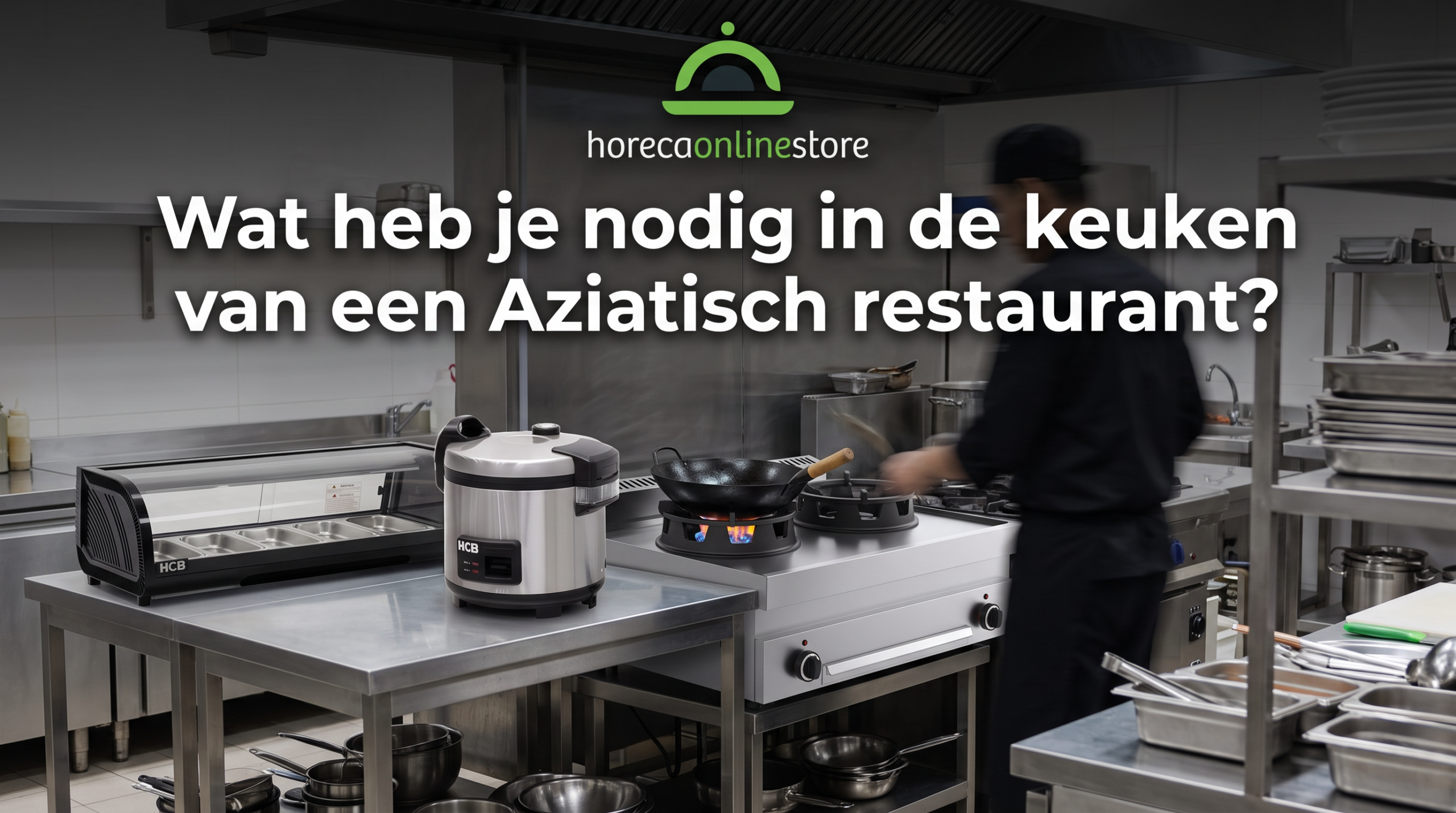
A successful Asian restaurant kitchen starts with the right layout and equipment that suits your menu. The right kitchen equipment helps you work efficiently, hygienically, and consistently during peak hours. Consider professional commercial rice cookers for large volumes, powerful wok burners for quick cooking, and refrigerated sushi display cases for an attractive and safe presentation.
Exactly what equipment you need depends on the restaurant concept. A wok restaurant has different requirements than a sushi restaurant, takeout shop, or catering business. In this article, you’ll learn what to look for when setting up your kitchen and when purchasing a rice cooker, wok burner, and sushi display case.
Choosing Asian restaurant kitchen equipment based on your concept
Don’t start with a product—start with your workflow. First, identify which dishes you prepare, how many orders you process during peak hours, and which tasks occur simultaneously.
For example, a wok restaurant needs one or more wok stations, an appropriate exhaust system, workspace for mise-en-place, and sufficient refrigeration for vegetables, sauces, meat, and fish. At a sushi restaurant, the emphasis is more on refrigerated storage, hygienic preparation, rice cooking, and presentation. A takeout shop often needs a compact yet efficient setup, while a catering company primarily requires flexibility and transportation options.
Therefore, make a list in advance of:
- the number of servings per hour during peak times;
- the dishes prepared simultaneously;
- the required storage for refrigerated, frozen, and dry ingredients;
- the available space and traffic flow;
- the required connections for gas, water, and electricity;
- how you organize food safety and temperature logging.
This will help you avoid buying an appliance that is too small in practice, doesn’t fit well in the kitchen, or doesn’t align well with your production process.
The Basic Equipment of an Asian Restaurant Kitchen
In addition to a rice cooker, wok burner, or sushi display case, a professional kitchen consists of several components that together determine the workflow. A good foundation typically includes professional refrigerators and freezers, a refrigerated prep table, stainless steel prep tables, a suitable exhaust system, a dishwashing station, and a professional dishwasher.
Practical tools are also important. These include GN containers for mise-en-place, shelves for dry goods, cutting boards for different product groups, digital thermometers, and lockable storage containers. In some kitchens, a blast chiller can be useful for cooling prepared dishes in a controlled manner, but whether it’s necessary depends on your menu and workflow.
When planning the layout, ensure a logical flow from storage to prep, cooking, and serving. Keep raw ingredients separate from prepared dishes and allow sufficient space around hot equipment. This not only increases efficiency but also helps prevent cross-contamination and unsafe working conditions.
Choosing a Professional Commercial Rice Cooker
Rice is an important part of the menu in many Asian cuisines. A professional-grade rice cooker for the foodservice industry offers greater capacity and ease of use than a household model. In addition, the right appliance ensures that rice is cooked evenly and can be kept warm for a certain period of time.
Consider capacity and peak production
Determine how much cooked rice you’ll need during the busiest time of the day. When doing so, consider not only the number of seats but also takeout orders, delivery, and dishes that use multiple servings of rice. Keep in mind the difference between the amount of uncooked rice and the final volume after cooking.
A rice cooker that’s too small requires multiple cooking cycles and puts extra pressure on the kitchen staff. A model that’s too large, on the other hand, takes up unnecessary space and can be impractical if you rarely use its full capacity.
Cooking Function and Keep-Warm Mode
Many professional rice cookers automatically switch to the keep-warm setting after cooking. This is useful during service when portions aren’t all served at the same time. Be sure to check how long and under what conditions the appliance can safely keep the rice warm. Always follow the product manual and your own HACCP procedures.
Also note:
- the power rating and connection type, for example, 230 volts;
- the inner pot and the quality of the nonstick coating;
- a lid that seals properly;
- overheating protection;
- a removable inner pot for easy cleaning;
- clear controls and indicator lights;
- the availability of replacement parts.
For sushi, a separate rice warmer or sushi pan might also be a good option. This allows you to keep the prepared rice ready to use without having to take up cooking capacity again.
Choosing a wok burner for a professional kitchen
A wok burner must deliver heat quickly and reliably, but the highest power output isn’t necessarily the best choice. Consider the type of dishes, the pan size, the number of wok stations, and the available gas supply.
Power is just one selection criterion
Higher power can be useful for quick cooking and large pans. However, heat distribution, ease of use, and stability are also important. A wok burner that’s difficult to regulate may be less convenient to use in practice than a model with slightly lower but easily controllable power.
Therefore, consider:
- the power output in kilowatts;
- the appropriate type of gas and gas pressure;
- the presence of a thermocouple or other flame safety device;
- a stable pan support ring for various wok sizes;
- a removable drip tray;
- ease of access to the burner and control knobs;
- the ability to clean parts thoroughly.
For example, a Maxima tabletop wok burner is equipped with a power output of 12.0 kW, a thermocouple, a pilot light, and a removable drip tray. This is an example of a product, not a general standard for every Asian kitchen.
Consider ventilation and installation
Wok cooking generates a lot of heat, steam, and cooking fumes. A professional exhaust system is therefore an important part of the wok station. Have gas appliances connected and inspected by a qualified installer. Check in advance whether the existing gas supply and exhaust system are suitable for the selected appliance.
Position a wok burner so that employees can move safely and hot pans do not obstruct a busy walkway. A good drip tray and a smooth, easy-to-clean surface make daily maintenance easier.
Buying a sushi display case: what should you look for?
A sushi display case serves two purposes: safely storing refrigerated products and presenting dishes in an appealing way. For sushi, sashimi, and other refrigerated dishes, temperature control, hygiene, and visibility are essential.
When comparing sushi display cases, consider:
- the total capacity and available display width;
- the layout, for example, with GN containers;
- the type of cooling, such as static or ventilated cooling;
- the adjustable temperature range;
- a digital temperature display;
- accessibility for filling and cleaning;
- lighting, such as LED;
- automatic defrost, if available;
- energy consumption and noise level;
- the ability to record temperatures.
The exact temperature settings vary by model and product application. Therefore, always check the technical specifications, the user manual, and the requirements in your HACCP plan. A display case must not only present products attractively but also provide sufficiently stable cooling under the conditions in which you use it.
Do not place the display case directly next to a heat source or in direct sunlight. Minimize the time the door or lid is open, and clean surfaces according to a set schedule. Also, check regularly to ensure that the temperature matches the set value.
Food Safety Practices for Rice, Stir-Fry Dishes, and Fish
A professional kitchen requires appropriate procedures for receiving, storing, preparing, holding, cooling, and serving food. Follow your HACCP plan or the applicable hygiene code and document temperature checks.
The NVWA specifies, among other things, that refrigerated food in the hospitality industry must be stored at 7 °C or lower and that hot food must be kept at 60 °C or higher. According to these guidelines, prepared products that are being cooled down must be brought to below 7 °C within five hours. Always check the most current regulations and the requirements that apply to your business.
Practical considerations include:
- use a reliable, calibrated probe thermometer;
- record temperatures in refrigerators, display cases, and food warming equipment;
- store raw fish separately from prepared sushi and vegetables;
- use clean utensils for different product groups;
- Reheat prepared rice and other products in a controlled manner;
- Clean countertops, cutting boards, and equipment according to a set schedule;
- Keep ingredients out of the refrigerator for as short a time as possible.
A consistent procedure is especially important when handling rice and raw fish. Equipment supports food safety practices but does not replace the responsibility of the business owner and the kitchen team.
Purchasing Checklist for Asian Kitchen Equipment
Use this checklist before placing an order:
- Capacity: Does the production capacity match your peak volume?
- Space: Does the appliance fit in the planned workspace without blocking traffic flow?
- Connections: Are the gas, electricity, water, and drain connections suitable?
- Safety: Are flame protection, overheat protection, and stable placement ensured?
- Cleaning: Are the inner pan, drip tray, filters, and other parts easy to clean?
- Operation: Can employees use the machine quickly and without errors?
- Maintenance: Are wear parts and replacement parts available?
- Warranty and service: What warranty and support are included?
- Total costs: What are the purchase, energy, maintenance, and any installation costs?
- Delivery: Is the appliance available from stock, and when can you start using it?
At Horeca Online Store, you’ll find professional foodservice equipment for various restaurant concepts and price ranges. You’ll benefit from low prices, fast delivery from our own inventory, and at least a one-year carry-in warranty. Orders of €300 or more qualify for free shipping, subject to the online store’s terms and conditions. Customer service can help you compare capacity, connections, and applications.
Frequently Asked Questions About Asian Restaurant Kitchen Equipment
What kind of rice cooker do I need for an Asian restaurant?
Choose a professional rice cooker based on the number of servings you’ll need during your busiest times. Consider cooking capacity, keep-warm function, power, ease of cleaning, and overheat protection. Compare the listed capacity with your own portion sizes and take takeout and delivery orders into account.
How much power should a wok burner have?
That depends on your menu, pan size, cooking speed, and number of wok stations. Power in kilowatts is just one criterion. Also check the gas supply, flame safety features, pan ring, exhaust system, and installation. Have the suitability of gas equipment professionally assessed in advance.
What temperature should a sushi display case be set to?
The correct temperature depends on the product, the model, and your food safety procedures. Check the technical specifications and follow your HACCP plan. Measure the actual temperature regularly with a reliable thermometer and do not rely solely on the display setting.
Is a household rice cooker suitable for a restaurant?
For occasional or very limited use, a household model may seem sufficient, but for professional production, capacity, durability, keep-warm function, and ease of cleaning are important considerations. A commercial rice cooker is generally better suited for intensive use and larger volumes.
What other equipment do I need besides a wok burner and a rice cooker?
The basic setup usually consists of a refrigerator, freezer, stainless steel work tables, exhaust hood, dishwashing station, dishwasher, GN containers, and temperature monitoring equipment. Depending on your concept, you can add a sushi display case, refrigerated workbench, deep fryer, steamer, or blast chiller.
Conclusion: Choose equipment based on your workflow
The best Asian restaurant kitchen equipment aligns with your menu, capacity, and workflow. A professional rice cooker supports consistent production, a well-chosen wok burner enables quick preparation, and a suitable sushi display case combines presentation with controlled refrigeration.
First, map out your workflow, and then check capacity, connections, safety, cleaning, and service. Browse the selection of professional foodservice equipment at Horeca Online Store, or contact customer service for advice on the right solution for your Asian restaurant.